When I was a high school teacher, I often asked my students a simple question:
What problem in the world do you want to help solve?
The answers rarely had anything to do with finding the highest-paying job. They wanted to reduce homelessness. Protect the environment. Improve mental health. Make schools more inclusive. Stand up for people whose voices weren’t being heard.
Their dreams reminded me that young people don’t just want careers—they want purpose.
As we recognize World Youth Skills Day on July 15, we’re reminded that preparing young people for the future means much more than teaching technical skills. This year’s theme, “Skills for a Shared Future,” invites us to rethink what it truly means to equip the next generation for a rapidly changing world. As artificial intelligence, climate change, and shifting economies reshape our societies, technical knowledge alone won’t be enough. Young people also need the skills to collaborate across differences, think critically, solve complex problems, communicate effectively, and advocate for human dignity.
Those aren’t just workplace skills. They’re human rights skills.
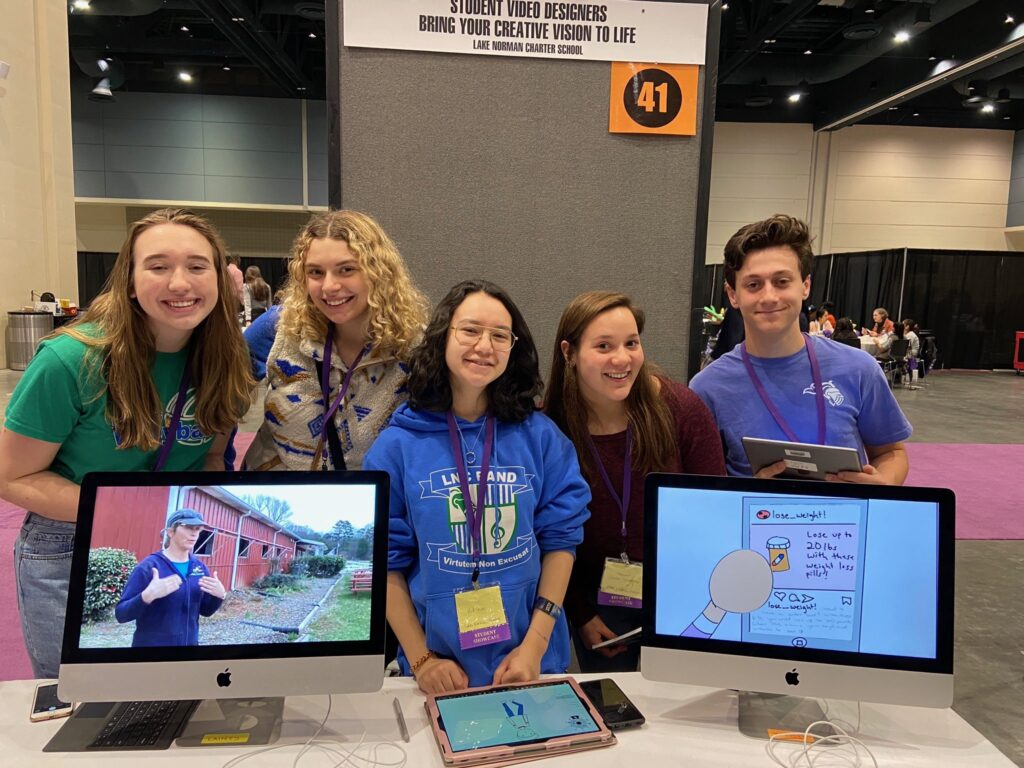 Students present their media projects for change at a state conference.
Every young person deserves the opportunity to thrive
Around the world, millions of young people continue to face barriers to education, employment, and training. While youth employment has improved in recent years, progress has been uneven, and far too many young people—especially young women—remain excluded from education, decent work, or opportunities to build meaningful careers.
Investing in skills isn’t simply an economic priority. It’s a human rights issue.
The right to education includes access to learning that prepares people to participate fully in society. Education should not only help young people earn a living, but also empower them to contribute to their communities, understand their rights, and help shape a more just future.
The most valuable skills are deeply human
I spent eleven years teaching Spanish and Digital Multimedia & Global Citizenship at a public charter school in North Carolina. Like many educators, I taught grammar, technology, and digital media. But the lessons I hope my students remember most had little to do with conjugating verbs or learning new software.
We built water filters and clean-burning stoves with families in Guatemala. Students designed public awareness campaigns about mental health and homelessness. They created podcasts, videos, and social media campaigns to educate others. They learned how to tell stories ethically, listen with empathy, collaborate across cultures, and turn ideas into action.
I watched students who were quiet in traditional classrooms become confident leaders when they discovered a cause they cared about. Their motivation changed because the work mattered to someone beyond themselves.
The skills they developed—curiosity, creativity, resilience, teamwork, communication, ethical leadership—are exactly the qualities our communities need today. They’re also the skills that technology cannot replace.
Human rights education prepares young people to lead
Human rights education is sometimes misunderstood as teaching about international treaties or legal frameworks. While those are important, its greatest value lies elsewhere.
It helps young people ask thoughtful questions. It encourages them to recognize injustice and imagine alternatives. Human rights education teaches them how to engage respectfully with people whose experiences differ from their own. It builds confidence to participate in civic life and equips them to solve problems together rather than deepen division.
These are practical skills.
Whether a young person becomes a software engineer, teacher, entrepreneur, healthcare worker, or community organizer, understanding human rights helps them make better decisions, build stronger relationships, and create workplaces and communities where everyone can thrive.
A shared future requires shared responsibility
Human rights advocates often focus on responding to today’s urgent challenges. But building a better future also means investing in the people who will inherit it.
That investment cannot stop at teaching young people how to adapt to change. We should be helping them become the people who create positive change.
Educators, nonprofits, governments, employers, and communities all have a role to play. We can create opportunities for young people to lead projects, solve real-world problems, volunteer in their communities, develop digital and media literacy, and participate in decisions that affect their lives.
Young people don’t need us to hand them all the answers.
They need opportunities to ask bold questions, develop meaningful skills, and believe their voices matter.
Looking ahead
One of the greatest privileges of my career has been watching former students grow into educators, nonprofit leaders, entrepreneurs, healthcare professionals, and advocates. Their paths have been different, but the qualities that helped them succeed have been remarkably similar: empathy, curiosity, resilience, collaboration, and a willingness to serve others.
Those are the skills that strengthen communities.
Those are the skills that advance human rights.
And those are the skills that will help build the shared future we all hope to see.
Get Involved
If you lead a student organization, teach at a university, or work with emerging advocates, we’d love to connect.
New Tactics in Human Rights offers practical human rights education resources, guest speakers, and interactive learning opportunities that help students build the skills to create positive change.
We also facilitate customized workshops using the Strategic Effectiveness Method—a proven framework that has helped human rights organizations and movements around the world strengthen their advocacy. Whether you’re looking to introduce students to human rights or build advocacy skills within your organization, we’d be happy to explore how New Tactics can support your group.